
Seed and mulch for eastern Nebraska
Hydroseeding in Omaha, NE
New lawns, slope cover and site stabilization on loess soil that washes easily and grows grass well.
- Site walk and a written estimate at no charge
- Seed blends picked for eastern Nebraska cool-season lawns
- Silt fence and inlet protection priced as their own line items
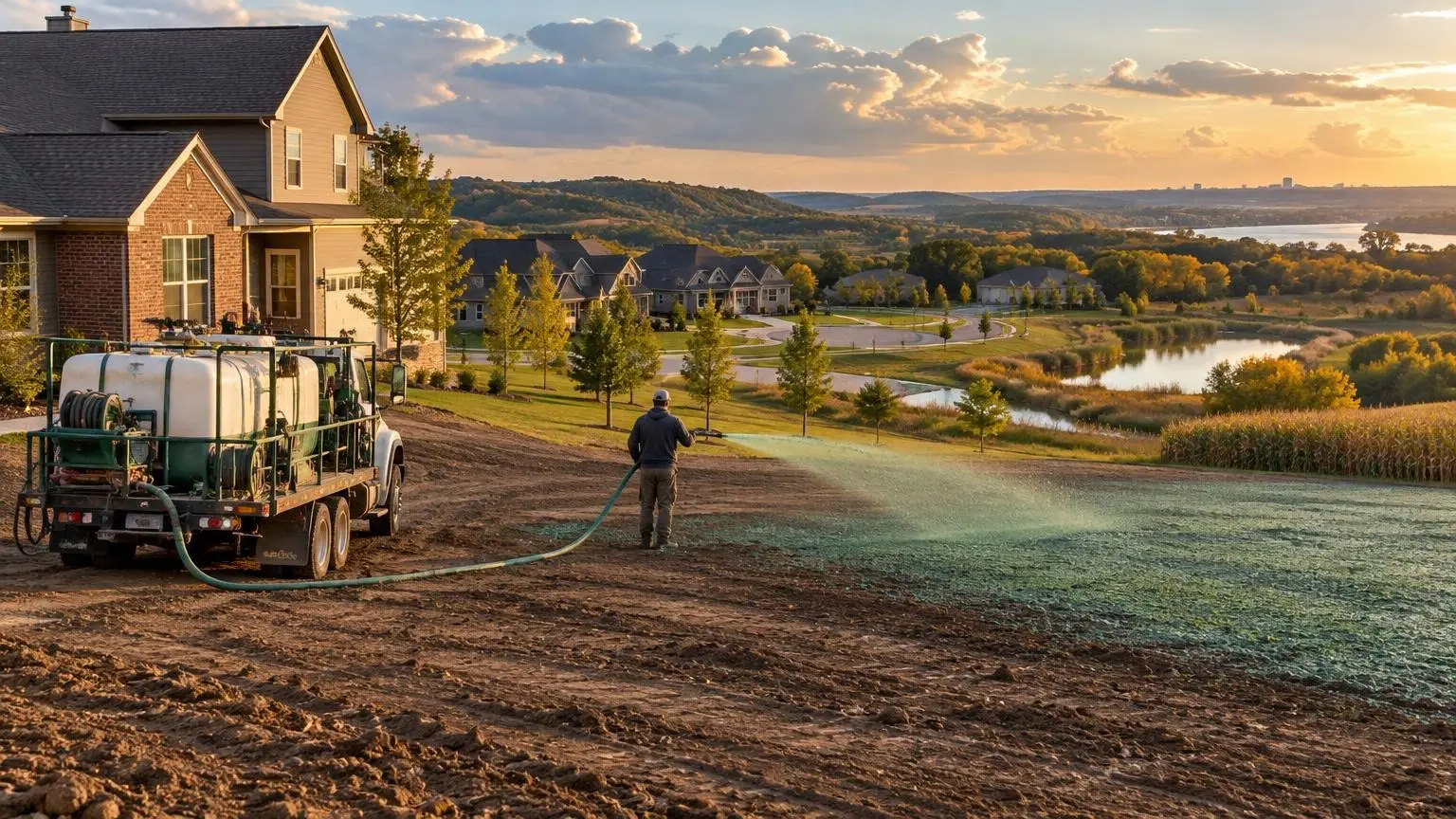
Grass From a Tank, Planned Around Omaha Rain
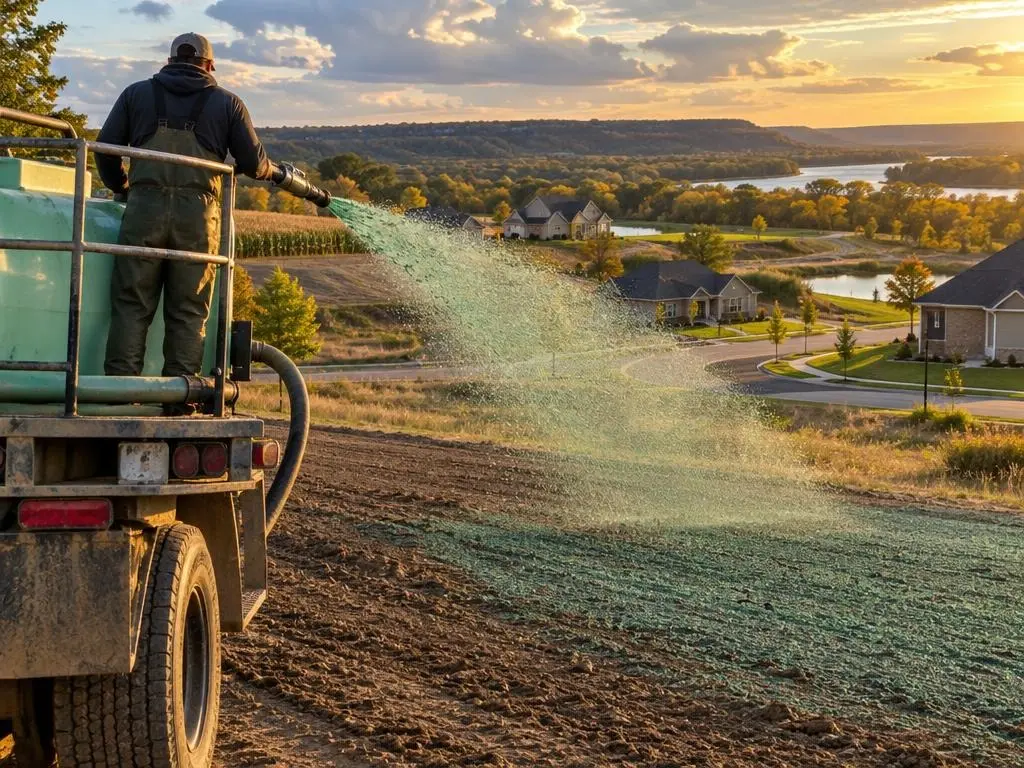
Hydroseeding in Omaha is how a lot of bare ground turns into lawn: new-construction lots in the west end, yards torn up by sewer or water work, banks behind a retaining wall, and the slopes along a new street. One tank holds the whole recipe: grass seed, a wood or paper fiber mulch, starter fertilizer, a tackifier that helps it stick, and water. We spray that slurry evenly over prepared soil, and the green dye shows us exactly where it has landed. Nebraska Extension notes that hydroseeded grass generally shows in five to seven days, where dry-sown seed takes two to three weeks, because the mulch holds moisture right against the seed. Hydro seeding also lets one crew cover a large or oddly shaped area in a single visit.
Loess: good for grass, quick to wash
Much of the ground around Omaha is loess, a wind-laid silt that covers large parts of the Great Plains in Nebraska. It is made mostly of silt and fine sand with 20 percent clay or less, and it is fertile. It is also the kind of soil that will stand in a steep bank for years and then lose its face in one hard rain once the cover is gone. Even well-managed loess farmland can lose a lot of soil each year to erosion. A bare lot in Elkhorn or Papillion behaves the same way. That is the main reason hydroseeding is popular here: the mulch layer starts protecting the surface the day it goes down, long before the grass roots can hold anything.
The 1964 soil survey of Washington County, just north of the city, illustrates a Sharpsburg-Marshall soil association, and the Marshall series has been sampled across eastern Nebraska and western Iowa. When a builder strips topsoil, what is left on top is often the paler, tighter subsoil. We check what is on the surface before we seed, and we talk about topsoil if the lot needs it.
When to seed in eastern Nebraska
Omaha lawns are cool-season grass. Nebraska Extension recommends tall fescue for eastern Nebraska and Kentucky bluegrass mostly for the western half of the state, though bluegrass blends are common in shaded or irrigated yards here too. The recommended seeding window for both is August 15 to September 15. Extension educators point out that each week of delay past that window can add two to four weeks to the time the grass needs to mature before winter, and that tall fescue should go in no later than mid-September because its seedlings are slow to harden for cold.
Spring seeding works, but it comes with more weed pressure and a short run before July. Eppley Airfield's 1991 to 2020 normals put the average July high near 88 degrees, with about 29 days a year at 90 or hotter. Young cool-season grass struggles in that heat, so a May seeding needs steady water through its first summer. For jobs that cannot wait, dormant seeding between late November and March is an option on some sites: the seed sits in the soil and germinates when spring warms it.
Thunderstorms and runoff
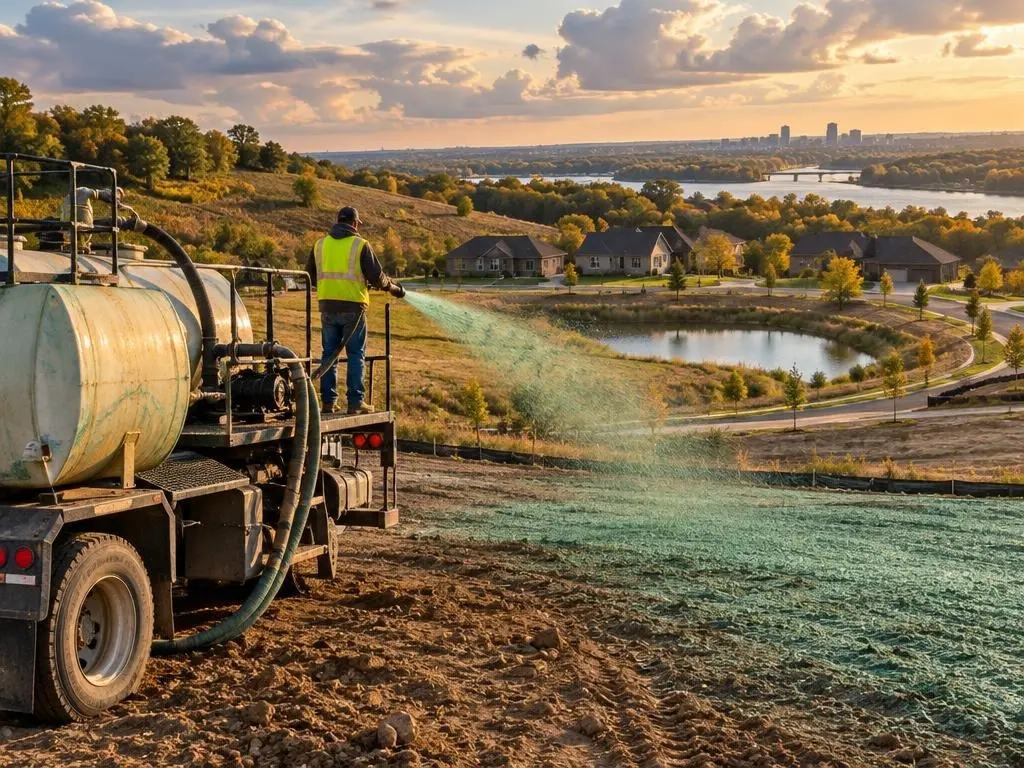
Omaha's normals show about 32 inches of precipitation a year, and May, June and August each average more than four and a half inches. The city's humid summers bring frequent thunderstorms, and a short, heavy storm on fresh grade is when soil leaves a site. On flat yards a standard hydromulch rate is usually enough. On slopes, swales and the backs of curbs we raise the mulch rate, add an erosion control blanket, or both. On building sites, silt fence goes in on the downhill margin and street inlets get protected before any seed is sprayed.
Sod, hydroseed or dry seed
Sod looks complete on install day and is the right answer for a small front yard that has to look done for a closing. It costs the most, it needs heavy watering, and on a big lot the price climbs quickly. Dry grass seeding by hand or with a drill is the cheapest route, but bare seed on loess can wash into the low corner or feed the birds before it sprouts. Nebraska Extension places hydroseeding a bit above dry seeding on cost and generally below sod. For most new-construction yards, slopes and repair areas larger than a few hundred square feet, it lands in the middle on price and near the top on how well it holds the soil.
Stormwater rules on building sites
Much of Omaha and its growing suburbs drain to the Missouri through the Papillion Creek watershed, which covers 402 square miles of Washington, Douglas and Sarpy counties through the Little, Big and West Papillion creeks. The Papillion Creek Watershed Partnership requires a grading permit on top of the state's construction stormwater permit once a project's disturbed footprint reaches one acre, or less if it is part of a larger development. Those projects need a stormwater pollution prevention plan, and City of Omaha staff check sites for compliance. For builders and site contractors, our hydroseeding, blankets and silt fence are the field side of that plan: getting disturbed soil covered and keeping sediment out of inlets and creeks.
What happens after we leave
The first three weeks decide most jobs. New seed needs the top half inch to an inch of soil kept damp, which in warm weather means a light sprinkle two to three times daily. As the grass fills in we taper to fewer, deeper waterings. Expect to mow for the first time roughly four to six weeks out, with a sharp blade at the highest setting. We leave written instructions and answer the phone if something looks off.
Hydroseeding services in Omaha are not all set up for the same jobs. One hydroseeding company may only do residential lawns, another only highway and commercial work. We do both, plus the grading, topsoil, blankets and silt fence that a seeding job often needs first. Call (402) 704-4105 with the address and a rough size, and we will set up a visit.
Why Homeowners Call Hydroseeding Omaha
We price the prep, not just the spray
Grading, topsoil, blankets and silt fence are written as separate lines, so you can see what each part costs.
Seed for this side of the state
Tall fescue blends for most sunny eastern Nebraska yards, with bluegrass or fine fescue mixed in where shade or irrigation calls for it.
Straight talk on timing
If a July seeding is likely to struggle, we say so and offer a late-August date or a dormant seeding instead.
Slope and runoff first
We look at where water leaves your lot before choosing a mulch rate or a blanket.
Common Questions
What does an Omaha homeowner typically pay to hydroseed a yard?
Depending on which national guide you read, residential hydroseeding runs from about $0.06 up to $0.35 a square foot, and HomeAdvisor's normal range for a project is $650 to $2,200. Most companies also have a minimum charge; LawnStarter puts it at $300 to $500. Slopes, extra grading or topsoil raise the total. Your bill matches the figure on the estimate you approve with us.
What grass seed works for Omaha lawns?
Nebraska Extension recommends tall fescue for eastern Nebraska, with Kentucky bluegrass more common in the west. Turf-type tall fescue handles Omaha's summer heat and dry spells well. We often blend in some bluegrass for sunny lawns that will be irrigated and use fine fescue in heavy shade.
Which weeks of the year give Omaha grass seed the strongest start?
August 15 to September 15 is the window Nebraska Extension recommends for cool-season grass. Spring after the soil can be worked is the second choice. Summer seeding is possible with steady watering, and dormant seeding from late November through March is an option for some sites.
How soon can I run a mower over new hydroseed?
Usually about four to six weeks, once most of the grass is three to four inches tall. Mow with a sharp blade at the highest setting and do not take off more than a third of the height.
Will hydroseed wash away in a heavy rain?
The tackifier and mulch hold it far better than dry seed, but a big storm on a steep, freshly graded slope can still cut rills. That is why we raise the mulch rate or add an erosion control blanket on steeper ground and swales.
Do I need a permit to seed my yard?
Not for seeding a normal residential yard. Permits come in when the disturbed ground totals an acre or more, or the job belongs to a larger development; in the Papillion Creek watershed those need a state stormwater permit and a local grading permit. Builders and site contractors usually hold those, and our work fits into their plan.
Is hydroseeding better than sod?
It depends on the job. Sod is instant but costs more and is hard to fit on curves and slopes. Hydroseed costs less, covers irregular ground evenly and roots into the soil you have, but it takes a few weeks of watering before it looks like a lawn.
Seeding Both Sides of the Missouri
We work in Omaha and across the metro on both sides of the river. In Sarpy County that means Bellevue, Papillion, La Vista, Gretna and Springfield, plus the newer subdivisions in Elkhorn and Valley to the west. North of the city we seed in Fort Calhoun and Blair, and west toward the Platte in Fremont, Waterloo and Ashland. On the Iowa side we cover Council Bluffs, Carter Lake, Crescent, Missouri Valley and Glenwood. Ralston and Plattsmouth round it out. The ground changes a lot across that area: steep loess bluffs at Crescent and Glenwood, flat sandy river bottom at Valley and Carter Lake, mature shaded yards in Ralston, and fresh grade in Gretna. Open any town below for the soil, slope and drainage notes specific to it.
- Hydroseeding in Omaha, NE
- Hydroseeding in Bellevue, NE
- Hydroseeding in Papillion, NE
- Hydroseeding in La Vista, NE
- Hydroseeding in Gretna, NE
- Hydroseeding in Elkhorn, NE
- Hydroseeding in Council Bluffs, IA
- Hydroseeding in Ralston, NE
- Hydroseeding in Springfield, NE
- Hydroseeding in Blair, NE
- Hydroseeding in Fremont, NE
- Hydroseeding in Plattsmouth, NE
- Hydroseeding in Valley, NE
- Hydroseeding in Glenwood, IA
- Hydroseeding in Ashland, NE
- Hydroseeding in Carter Lake, IA
- Hydroseeding in Fort Calhoun, NE
- Hydroseeding in Crescent, IA
- Hydroseeding in Waterloo, NE
- Hydroseeding in Missouri Valley, IA
Our Services
Six kinds of work, from a single yard to a builder's whole phase, all aimed at getting soil covered and grass growing.
New Lawn Hydroseeding
A full hydroseed lawn for new homes and stripped yards, with seed chosen for eastern Nebraska.
Learn more →Builder & Commercial Hydroseeding
Hydroseeding for subdivisions, commercial pads, detention basins and right-of-way, sized by the acre.
Learn more →Slope & Erosion Control
Blankets, heavy hydromulch and seed for loess banks, swales and ditch lines that wash every time it storms.
Learn more →Silt Fence & Inlet Protection
Silt fence installation, inlet protection and repairs that keep sediment on your site and out of the street.
Learn more →Grading & Topsoil Prep
Yard grading, fine grading and topsoil so seed lands on a surface that drains and grows.
Learn more →Lawn Repair & Overseeding
Lawn renovation, bare-spot repair and fall overseeding for thin or damaged Omaha yards.
Learn more →Book a Site Visit for Your Lot
Free visits and written estimates across Omaha and Council Bluffs.